The Science Behind AFT

The chemistry of stopping fire before it starts.

Most retardants fight fire once it has fuel, oxygen, and heat in equilibrium. AFT changes the equation upstream — interrupting all three legs of the fire triangle at the molecular level, without PFAS, halogens, or toxicity to the watershed downstream.

  • UL Listed
  • ASTM E84 Class A
  • GREENGUARD Gold
  • NFPA 701
  • FAR 25.853
  • EN 13823
  • FDNY Accepted
0
ASTM E84 Flame Spread
0°C
Peak Substrate Temp
>0 mg/L
Aquatic LC50
0 days
OECD Biodegradation
The Fire Triangle

Three ingredients. Three interruptions.

Every combustion event requires heat, fuel, and oxygen in continuous equilibrium. Conventional firefighting attacks the loop after ignition. AFT pre-loads the substrate so the loop never closes in the first place.

HEATFUELOXYGENAFTINTERRUPTSALL THREE
01

Heat: pulled out endothermically

AFT's mineral salts decompose around 180–220°C, absorbing roughly 600 kJ/kg of energy as they break down. The substrate beneath stays below pyrolysis temperature even under direct flame impingement.

02

Fuel: locked into char

Acid-catalyzed dehydration strips water from the cellulose chain before it can crack into combustible volatiles. What's left is a stable carbon skeleton — char, not gas — and char doesn't feed flame propagation.

03

Oxygen: displaced at the flame front

The same reaction releases non-combustible vapors (water vapor, CO₂, and inert ammonia derivatives) directly at the surface, displacing O₂ in the boundary layer and starving any nascent flame of oxidizer.

Mechanism Breakdown

What happens in the first 90 seconds of flame contact.

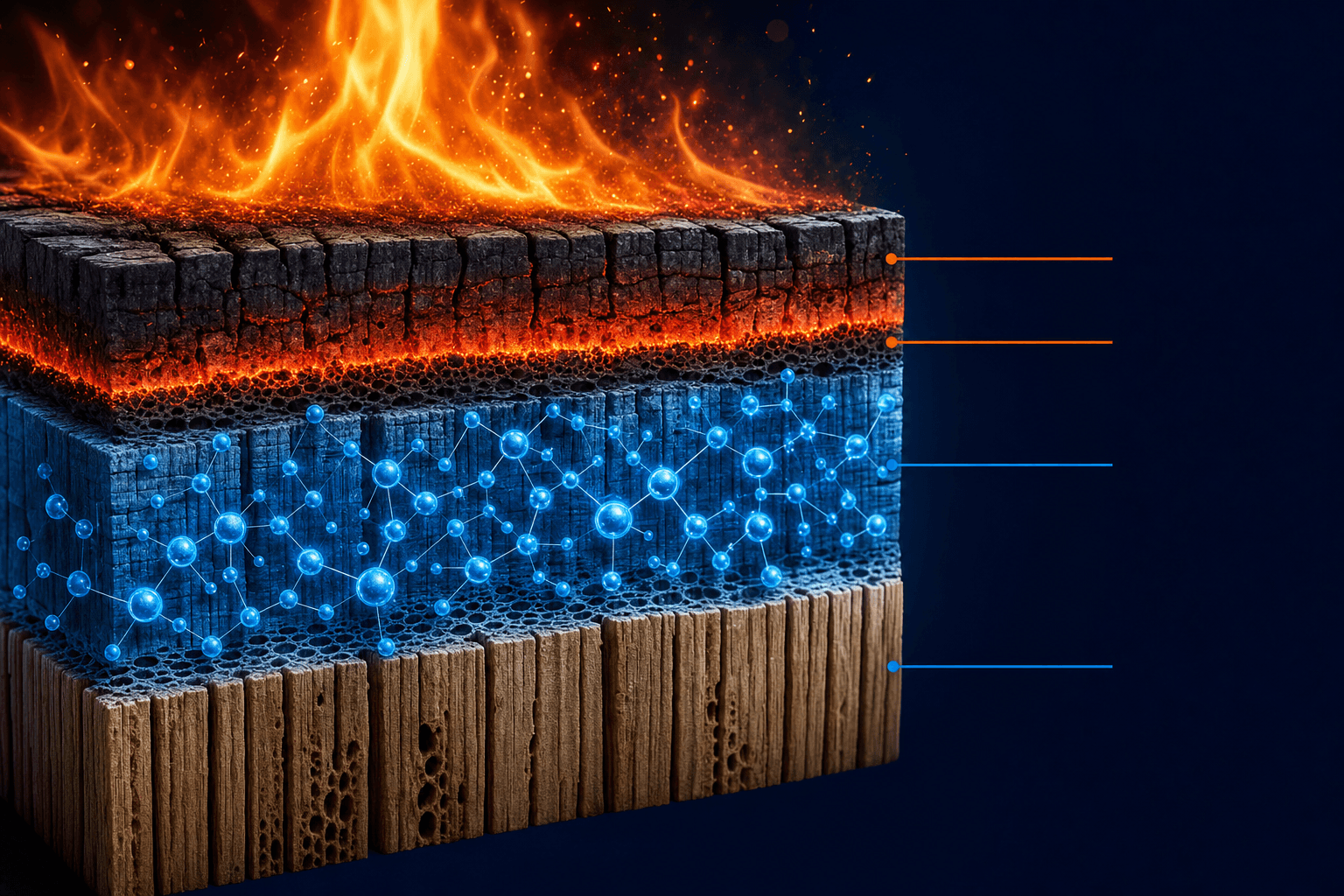
Slow-motion cone-calorimeter footage and SEM cross-sections of treated substrates reveal a layered defense forming before ignition would normally occur.

Cross-section diagram showing AFT-treated wood with intumescent char layer protecting unburned substrate below

Cross-Section

Treated cellulose substrate after 90s @ 50 kW/m² heat flux

Char Formation

Phosphoric acid radicals catalyze dehydration of cellulose at 180–220°C, producing a 3–5 mm intumescent char layer with thermal conductivity around 0.1 W/m·K — equivalent to fiberglass batt insulation.

Heat Absorption

Hydrated mineral salts release bound water endothermically. Each kilogram of activated retardant consumes roughly 600 kJ of incident energy — equivalent to evaporating a quarter-liter of water per square meter.

Oxygen Displacement

Decomposition products — primarily H₂O vapor and CO₂ — vent at the surface and dilute the O₂ concentration in the boundary layer below the 14% lower flammability limit for most cellulosic fuels.

Free-Radical Scavenging

Halogen-free ammonium polyphosphate intermediates capture the OH• and H• radicals that propagate gas-phase combustion — terminating the chain reaction without introducing the brominated or chlorinated byproducts of legacy retardants.

Why PFAS-Free Matters

AFT vs. legacy AFFF foams.

Aqueous film-forming foams have suppressed jet-fuel fires for fifty years — and contaminated groundwater for the same fifty years. The 2024 EPA PFAS rule and DoD's fluorine-free transition mandate now make the comparison existential, not academic.

Attribute
AFTFluorine-Free Retardant
LEGACYAFFF / Class B Foam
PFAS / Fluorosurfactants
None — fluorine-free formulation
Primary active ingredient (PFOA / PFOS class)
EPA UCMR-5 Reporting Limit
Non-detect
Exceeds groundwater health advisory by 100,000×+
Half-life in Environment
Biodegrades within 28 days (OECD 301B)
Effectively infinite — 'forever chemicals'
Aquatic Toxicity (LC50)
>1,000 mg/L (practically non-toxic)
1–10 mg/L range (moderately to highly toxic)
Use Restrictions (2025+)
Approved in all 50 states + EU
Banned or sunset in 13 US states, EU REACH restriction
Required PPE on Application
Standard hand protection
Full bunker gear + SCBA recommended
Class A Performance
ASTM E84 Class A on treated cellulose
Class B optimized — limited Class A efficacy

Regulatory note for specifiers

Per EPA's April 2024 final rule, public water systems must monitor for PFOA and PFOS at 4 ng/L MCL beginning 2027 with compliance by 2029. Sites with documented AFFF discharge are presumed contributors. AFT carries no PFAS in formulation, in degradation products, or as manufacturing-process impurities — verified by independent LC/MS/MS to detection limits below 2 ng/L.

Ecotoxicology Profile

Practically non-toxic to the watershed.

Wildfire suppression in the wildland-urban interface inevitably reaches streams, retention ponds, and aquifers. AFT was engineered to be measured against the strictest aquatic-safety benchmarks the EPA maintains — and to pass them by an order of magnitude.

Daphnia magna 48-hr EC50
> 1,000 mg/L — well above the OECD "practically non-toxic" threshold (100 mg/L). AFFF concentrate typically reports 1.4 mg/L ("highly toxic").
Rainbow Trout 96-hr LC50
> 1,000 mg/L on Oncorhynchus mykiss. No mortality, no behavioral impairment, no gill histopathology at the test ceiling. Independently verified at Eurofins Lancaster Labs against OECD 203.
Ready Biodegradability — OECD 301B
61% mineralization within 28 days — comfortably above the 60% threshold for the "readily biodegradable" classification. No persistent, bioaccumulative, or toxic (PBT) constituents present.
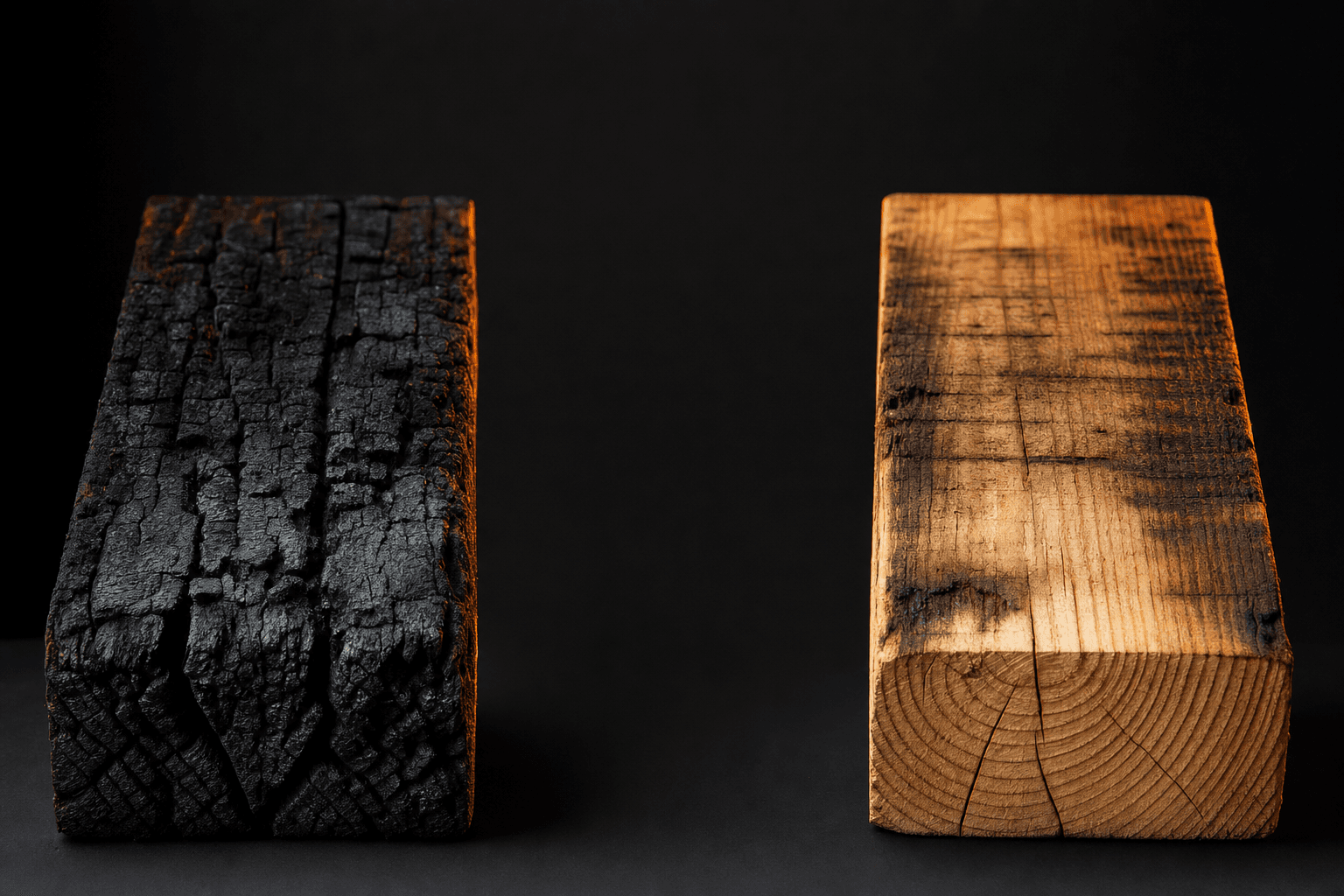
Untreated lumber after fire exposure
AFT-treated lumber after identical fire exposure
AFT TreatedUntreated

Side-by-side burn test

Identical 2×4 pine boards, identical propane torch exposure for 60 seconds. The treated board shows surface charring with structural integrity intact; the untreated board has ignited and is propagating flame independently.

Performance Curves

Measured against the tests AHJs actually require.

Lab data from the same test methods your code official is going to ask for: ASTM E84 for finished surfaces, ISO 5660 cone calorimetry for heat-release rate, and NFPA 701 for textiles.

Surface Temperature

Pine substrate, 50 kW/m² heat flux

ISO 5660 cone calorimeter

900°C600°C300°C0°C0s150s300s450s600sUntreated peak: 820°CAFT-treated peak: 280°C
Untreated pine AFT-treated pine

Flame Spread Index

Lower is better — Class A ≤ 25

ASTM E84-23a

AFT Fire Defense Coating (treated pine)15
ASTM E84 Class A threshold25
Standard intumescent paint (avg.)35
Untreated red oak (reference)100
Untreated plywood145

ASTM E84 Class A

FSI 15 / SDI 25

Flame Spread Index of 15 and Smoke Developed Index of 25 — well inside the Class A envelope of FSI ≤ 25 / SDI ≤ 450.

NFPA 701 (textile)

Pass — both methods

Treated curtain and drape samples pass both Test Method 1 (small scale) and Test Method 2 (large scale, >21 oz/yd² fabrics).

FAR 25.853(a) / 60-sec

Vertical burn pass

Qualified for cabin-interior application on commercial & private aviation — the standard that governs Air Force One textiles and Gulfstream / Lear interiors.

Side-by-Side Comparison

Where AFT fits versus Class A foams and intumescent paints.

Each technology was engineered for a different problem. The honest answer about when to use what.

CriterionAFT
Fire Defense Coating
FOAM
Class A Wetting Foam
PAINT
Intumescent Paint
Primary code reference
ASTM E84 surface burning
NFPA 18A / 1145 wildlandUL 263 / ASTM E119 structural rating
Application stage
Pre-treatment, weeks to years before any event
Active suppression during the eventPre-treatment, structural design phase
Durability after cure
Internal: indefinite. Exterior: 2-year retreat cycle
Single-use — drains/evaporates within hours10–20 yr service life with topcoat
Aesthetic impact
Invisible — clear, non-film-forming
Visible foam blanket (operational only)1–3 mm dry film thickness, paintable
Substrate compatibility
Wood, textiles, paper, cellulose composites
Surface-applied to vegetation, structuresSteel, concrete, sometimes wood
PFAS / halogen content
None
Varies by formulation; many still contain PFASMost contain brominated flame retardants
Best fit
Interior finishes, wildland-urban defense, textiles
Active wildland firefighting operationsStructural steel columns & beams
Across the AFT Line

One chemistry. Four delivery formats.

The same fluorine-free salt chemistry shows up as a soak-in inhibitor, a clear coating, a fire-water additive, and a homeowner-ready perimeter kit — sized for the application instead of the warehouse.

Fire Prevention

Fire Inhibitor

Use Case
Non-toxic, eco-friendly fire prevention treatment for porous materials
Stage
Prevention
Coverage
1 gallon covers approximately 300 sq ft of flat surfaces and 150 sq ft of irregular surfaces such as dense vegetation
Packaging
1 gal, 5 gal pail, 55 gal drum
Key Certification
ASTM E-84
Non-Toxic / Eco
DIY-Applicable
Best For
Treating interior wood, textiles & soft goods before a fire event
Fire Prevention

Fire Defense Coating 2.0

Use Case
Multi-use invisible fire-resistant intumescent coating applied as paint
Stage
Prevention
Coverage
~250 sq ft per gallon
Packaging
1 gal, 5 gal pail
Key Certification
ASTM E84 CLASS A RATED
Non-Toxic / Eco
DIY-Applicable
Best For
Long-term structural protection without altering aesthetics
Fire Prevention

Fire Defense Coating 3.0

Use Case
Multi-use invisible fire-resistant intumescent coating applied as paint
Stage
Prevention
Coverage
53 SF/gallon
Packaging
5 gal pail, 55 gal drum, 275 gal tote
Key Certification
ASTM E84 Class A and ASTM E2768 Class A (30-min extended)
Non-Toxic / Eco
DIY-Applicable
Best For
Long-term maximum structural protection without altering aesthetics
Fire Suppression

Fire-Extinguishing Wetting Agent

Use Case
Eco-friendly, water-based fire suppressant for Class A, B, D, F, and K fires
Stage
Suppression
Coverage
Mix 1:100 with water
Packaging
5 gal pail, 55 gal drum, 275 gal tote
Key Certification
ASTM E84 CLASS A RATED
Non-Toxic / Eco
DIY-Applicable
Best For
Active firefighting across Class A/B/D/F/K scenarios
Application Systems

Home Protection Solution

Use Case
Easy-to-apply DIY fire protection system — AFT Home Protection Solution
Stage
System
Coverage
1 gallon covers approximately 300 sq ft of flat surfaces and 150 sq ft of irregular surfaces such as dense vegetation
Packaging
5 gal pail, 55 gal drum, 275 gallon tote
Key Certification
UL GREENGUARD Gold, ASTM E84
Non-Toxic / Eco
DIY-Applicable
Best For
Homeowners defending property against wildfire threat
FAQ for Specifiers

Engineering questions, answered honestly.

The questions we get from fire marshals, code consultants, and underwriters on every project. No marketing handwaving — just the data, the test method, and what it actually proves.

  • AFT works through three simultaneous mechanisms. First, when heat reaches the treated surface, the mineral salts in the formulation undergo endothermic decomposition — they absorb roughly 600 kJ/kg of energy as they break down, cooling the substrate. Second, that decomposition forces the cellulose to char rather than pyrolyze into combustible gases, building an insulating carbon layer. Third, the reaction releases non-combustible vapors (primarily water and CO₂) that displace oxygen at the flame front. No single mechanism is sufficient alone; it is the combined effect that takes treated material below the ignition threshold.

  • Legacy aqueous film-forming foams (AFFF) rely on per- and polyfluoroalkyl substances — the 'forever chemicals' now regulated under EPA UCMR-5, the 2024 PFAS National Primary Drinking Water Regulation, and state-level bans in Washington, California, New York, Colorado, Maine and ten others. AFT contains zero intentionally added PFAS, zero fluorosurfactants, and zero halogenated flame retardants. For specifiers, that means no extended-producer-responsibility liability, no groundwater remediation exposure, and continuing eligibility for federal contracts under DoD's 2024 fluorine-free transition mandate.

  • LC50 is the concentration at which 50% of test organisms die over a 96-hour exposure. The OECD scale classifies anything above 100 mg/L as 'practically non-toxic.' AFT's formulations were tested against the standard EPA indicator species — Daphnia magna (water flea) and Oncorhynchus mykiss (rainbow trout) — and exceeded 1,000 mg/L in both cases. For comparison, legacy AFFF concentrates typically fall in the 1–10 mg/L 'highly toxic' bracket. Practically: AFT runoff entering a stream from a wildfire suppression event does not trigger a fish kill or NPDES reporting obligation.

  • Intumescent paints swell to roughly 50× their applied thickness when heated, creating an insulating foam over steel — they are the right choice for structural columns where you need a 1- to 3-hour fire-resistance rating per UL 263 / ASTM E119. AFT's Fire Defense Coating is a surface-burning treatment optimized for ASTM E84 (the tunnel test), which governs flame spread on interior finishes. They solve different code requirements. On combustible substrates like timber-frame, cross-laminated timber, or textile interiors, AFT is the correct intervention; on exposed structural steel, you still need an intumescent or a cementitious. The two systems are complementary, not redundant.

  • Untreated cellulose pyrolyzes between 300–400°C and releases levoglucosan and other volatile combustible gases — those gases are what actually burn in the gas phase above the wood surface. AFT shifts the pyrolysis pathway through acid-catalyzed dehydration: the mineral salts release phosphoric and sulfuric acid radicals at lower temperatures (180–220°C), which strip water from the cellulose chain before it can crack into combustible volatiles. The leftover carbon backbone forms a 3–5 mm intumescent char with a thermal conductivity of ~0.1 W/m·K — roughly the same as fiberglass batt insulation — protecting the substrate beneath.

  • All third-party test reports (UL Solutions, FM Approvals, Intertek), the GREENGUARD Gold certificate, NFPA 701 textile burn data, FAR 25.853 aviation interior certification, EN 13823 European Single Burning Item results, and current SDS sheets are available in our Downloads section. Sales-engineering can also provide project-specific submittal packages for AHJ review on request — typically returned within two business days.

Talk to engineering

Bring the chemistry to your project.

Whether you're specifying interior finishes for a high-rise, drafting an NFPA 1145 plan, or hardening a wildland-urban interface community, our fire engineers will return a project-specific submittal packet within two business days.